The next time my wife comments on my hat fetish, I'll point her int eh direction of this video:

Showing posts with label Sartorialism. Show all posts
Showing posts with label Sartorialism. Show all posts
10 January 2013

21 December 2012
Quality British hats
One (of many) of my quirks is a penchant for wearing hats, and admiring quality hats, so I found the article below quite interesting:

Christys' hats, Witney:
Christys is one of a handful of hat makers left in the UK. It supplies Lock & Co and Bates (neither of whom make their own hats) as well as having its own label. For much of its history Christys was the largest hat maker in the UK, with over 3000 staff at one point. (Today it is 30.)
Some of the Christys flanges are over 150 years old

Christys is also one of around 10 makers in the world that does both its own felting and blocking. Felting is the creation of the raw material. It involves blowing rabbit fur or sheep wool in a machine the size of a small office, to separate out the finest hairs. A second machine then blows the hairs onto a cone mould, while that mould emits steam. The combination of heat and moisture causes the hairs to bind together, forming felt. It’s a little like putting your merino wool sweater into the washing machine – it comes out shrunken, the hairs densely packed together. The felt is then rolled and compressed, to bind it more tightly.
An old '16 Guinea' - the original sewing machine for hats

The Christys felting (known as the wet side of hatting) is still done in Stockport, while the blocking is done in Witney, just outside Oxford. Christys acquired its Stockport felting facility in 1821. At that point the company was still owned and run by the Christys family, going back to Miller Christy who founded the company in 1773 in London.
With Luton perhaps a close second, Stockport was the traditional centre of the hat industry in England. The football clubs of both towns are still known as The Hatters. The two other big makers, Olney and Failsworth, are headquartered in Luton and Manchester respectively.

Interestingly, around a third of the Christys business today is making hats for the military and police force. The traditional Metropolitan police helmet has a plastic base but a felted outer layer that is formed on top of it. They also make panama hats and an astounding number of bowlers and toppers – 10,000 this year. That’s a bowler below being steamed before its edge is curled, prior to shipping.

I visited the Christys factory in Witney this week and will do a step-by-step post on the blocking side of the process after Christmas. As with many of the factories I have reported on, the age of the machinery involved makes them unique and fascinating places.

19 November 2012
Meet the Hatterites
I'd like to address the question below:
What makes a man wear a hat?For me, there are several reasons why, if I'm outside, I'm wearing a hat:
- It's anachronistic. (See this article.)
- It keeps my bald head warm in the winter, dry in the rain, and un-burned in the summer.
- Military indoctrination: My head feels naked if I'm not in one outdoors.
- My dad used a beat up old cap as his trucker "brief case". On occasion, I'll toss loose items in mine when I need them to stay in place. It's nostalgic.
 |
| I used this as a profile picture until someone thought I was in a ball cap. |
09 November 2012
Keeping costs in perspective
When I see something like the ad below, the first thing I want to do is convert it to present dollars:
The Duffer Coat, 1960:Fortunately, this is really easy to do using a tool from MeasuringWorth.com. This coat costing $29.95 in 1960 would cost $227.00 today. Even more fun is to peg the cost against the historic value of gold. Gold was $35.27/oz in 1960 (per Kitco), and is $1734.70 today, so while you could buy 1.2 of these coats for an ounce of gold in 1960, you can buy 7.6 of these coats with that same ounce of gold today.
Source:
(click to enlarge)
Yale Daily News - 11/9/60

Unfortunately, it's probably not that simple. That coat in 1960 probably had a lot of quality sewn into it. Following that theme and sticking with a brand that has a tradition in quality coats, Burberry has one that costs £895.00 ($1425.00), putting us back at 1.2 coats for an ounce of gold.
So, in my overly simplified analysis, an ounce of gold will still buy you the same quality coat today that it did in 1960.
NB: I am making a huge assumption that the coat in the ad is Burberry quality. I could be way off, but I have no way of knowing. I just take for granted that it wasn't manufactured in a 3rd world sweatshop in 1960.

23 October 2012
When the leader of the free world can't dress himself
I'll keep this non-partisan and voice my disdain for both President Obama and Governor Romney: If you have the money (and opportunities to play dress up) that both of these men most certainly have, is it too much to ask to be properly fitted for a white tie event?
Thanks to The Chap for pointing out this egregious faux pas on the part of both men. The comments there are definitely worth the read. To be honest, the image below also made me think of the cover of a recent edition of the Economist. One would think that both men would have people to ensure their outfits fit.

#TheChapMag White Waistcoat Divides a Nation
Thanks to The Chap for pointing out this egregious faux pas on the part of both men. The comments there are definitely worth the read. To be honest, the image below also made me think of the cover of a recent edition of the Economist. One would think that both men would have people to ensure their outfits fit.

For the sake of fairness, let's look at how some previous occupants of 1600 Pennsylvania Avenue fared:
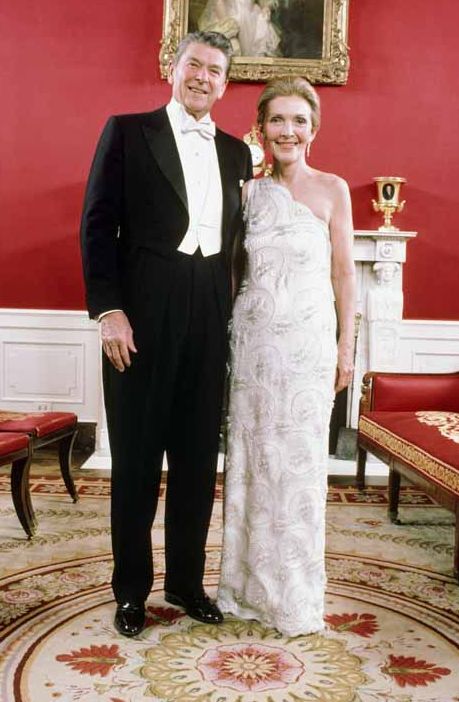 |
| http://www.blacktieguide.com/History/13-Yuppie_Pt2.htm |
 |
| http://www.blacktieguide.com/History/10-Jet_Age.htm |
I little more put together, don't you think?
 |
| http://www.cheap-neckties.com/blog/wrapper.php?/archives/2009/01.html |
Prince Philip, yes. President Bush, meh, not so much.
 |
| http://www.eisenhower.archives.gov/research/audiovisual/images/dde.html |
Not exactly white tie, but when you get a jacket named after you, you at least deserve an honorable mention.
Subscribe to:
Posts (Atom)