Showing posts with label Honor. Show all posts

23 July 2013

In praise of Sir Roderick Spode

I spent the past month or so watching the complete series of Jeeves and Wooster on Hulu, and I proudly proclaim that my favorite character was Sir Roderick Spode, 7th Earl of Sidcup.

John Turner as Roderick Spode
Nevermind the fact that the character was patterned after Sir Oswald Ernald Mosley; Lord Sidcup is an inspiration to all would-be benevolent meglomaniacs who want to make the world a better place. Unlike Bertie Wooster, that useless fop, Spode held himself with dignity and honor (except when Wooster was blackmailing him with the mere mention of "Eulalie") and sought to restore national pride in Britain. He even almost let his civic pride and duty to nation overcome him when he nearly cast aside his place amongst the Lords to run for Parliament, only through the manipulations of Jeeves (for the benefit of Wooster)  to be pulled back to his senses.

First, his vision. He knew what he wanted and worked toward achieving it. Before his elevation to the peerage, he sought out influential friends (Sir Watkyn Bassett) and established a source of income that allowed him the freedom to think on such noble causes such as British-made bicycles and umbrellas for all citizens.

Second, his influence. The Black Shorts were devoted to the cause of Spode. They donned the uniform, attended the rallies, and even fought the Communists in defense of their great leader. Granted, their membership was mainly young unmarried men in need of a hobby, and older men whose wives determined they needed a hobby.

Finally, his determination. As evidenced in the "Eulalie" fiasco, Spode was willing to do what it took to see himself reach the success that he desired. Any man who could design women's underwear AND lead a small army of fascists is a true man indeed.

So to all my fellow Walter Mittys out there, seeking a resolute and determined role model, let us learn from Roderick Spode and keep our heads high, even when the poo comes raining down.


12 July 2013

Appeal to the Queen to Make Colonel (RCAF, ret.) Chris Hadfield a Knight

I am an advocate in the recognition of those who have made significant achievements of benefit, not only for their homelands, but globally.  Thusly, I support the effort to petition for knighthood on behalf of Astronaut Chris Hadfield. His contributions to space exploration supersede national boundaries.

Excerpted from the petition:
May it please Her Majesty to honour retired Astronaut Chris Hadfield, a true Canadian and Commonwealth icon, with a substantive knighthood for his extraordinary achievements in space.
A former Royal Canadian Air Force pilot, Colonel Chris Hadfield was the first Canadian to walk in space. Hadfield has flown two space shuttle missions and served as commander of the International Space Station.
During the mission he gained popularity by chronicling life aboard the space station and taking pictures of the earth and posting them through Twitter and Facebook to a large following of people around the world. From his perch in orbit, he was a guest on television news and talk shows and gained immense popularity by playing his guitar in space. His rendition of David Bowie’s “Space Oddity” is easily considered to be “one of the best videos of all time.”
As the first Commonwealth citizen to command the ISS, Astronaut Chris Hadfield inspired people the world over, especially the next-generation of scientists and engineers, and once again brought international popular attention to space expeditions — all while running the most productive science mission to date. His exceptional achievements in space have made him, in the words of one BBC commentator, “the most famous astronaut since the days of Neil Armstrong and Yuri Gagarin.”
Given these outstanding contributions, we the undersigned believe a knighthood as something personal from the Queen, over and above any Canadian honours, would be highly appropriate to reflect the pride and gratitude of the whole Commonwealth family.
You can view the petition here:
Appeal to the Queen to Make Astronaut Chris Hadfield a Knight Petition | GoPetition

We don't have quite as elaborate an honors system in America, with the Presidential Medal of Freedom and Congressional Gold Medal being our highest honors, but I would argue that Colnel (RCAF, ret.) Hadfield's international service would make him a candidate for them as well.

[UPDATE: 22 July 2013]
The author of this petition closed it on 15 July with the following statement:
Please disregard this petition. It was conceived with good intentions, but its author now believes that it is inadvisable to petition for Royal Honours.
Additional comment available here

01 March 2013

Distinguished Warfare Medal, part II

The article below isn't new news, but a welcome development in the drama around the
Ranking of new "cyber-medal" comes under scrutiny: Two Republican members of Congress who are also military veterans have introduced a bill that would lower the rating of the new Distinguished Warfare Medal, which can be given to drone pilots and cyber warriors. The legislation would prohibit the medal ...See all stories on this topic »


I wrote about this last year when I first heard about the idea being floated, and I  still loath the notion of
a "Distinguished Warfare Medal" with such a high order of precedence given the low risk in obtaining it.  I am not the only veteran outraged by this, and the media has caught on:
The medal itself is not the issue: the precedence is. It is an insult to those who risk their lives in combat, and though I do not fall into that category, I hold those who did in too high a regard to allow this to remain silent. As I stated previously, the medal needs to be demoted significantly.

I think this sums it up pretty well:
http://www.brecorder.com/images/wall/2013/02/thumb/distinguished-warfare-medal-328x280.jpg
Here is a link to Representative Hunter's comments.

[Update: 6 March 2013]
Another link:
http://soldiersystems.net/2013/02/13/the-distinguished-warfare-medal-the-times-they-are-changin/

Also, in a meeting of the Tennessee Valley Chapter of the National Defense Industry Association, I heard this decoration referred to by the name that I will hereafter call it: the Fobbit Medal.

[Update: 12 March 2013]

22 February 2013

Ten Commandments of Chivalry

If you follow any of the major blogs in the "Manosphere", you might have noticed recently a bit of back and forth over the concept of Chivalry in the modern world. I'll stay neutral on that discussion, but I want to take a moment to comment on the ten commandments of Chivalry:
  1. Thou shalt believe all that the Church teaches and shalt observe all its directions.
    Claiming no creed nor doctrine outside that practiced by the first century Christians, I believe in the Gospel and the epistles, with their "primitive" form of Christianity that can be seen from the examples as recorded in the books that have been passed to us as the New Testament. I strive to "speak where the Bible speaks and be silent where the Bible is silent".
  2. Thou shalt defend the Church.
    The church to which I belong (and by extension, the congregation I worship with) claims no central authority other than Christ, thus the simple naming convention of claiming to be His church in a particular locale. Since my faith is spiritual, my battle is likewise, though I may face adversaries on the physical plane. This doesn't mean that one sits idly by to allow others to slander the Christian faith, but it also doesn't necessitate physical violence against the offender. Paul details our weapons is :

    10
    Finally, be strong in the Lord and in the strength of his might. 11 Put on the whole armor of God, that you may be able to stand against the schemes of the devil.12 For we do not wrestle against flesh and blood, but against the rulers, against the authorities, against the cosmic powers over this present darkness, against the spiritual forces of evil in the heavenly places. 13 Therefore take up the whole armor of God, that you may be able to withstand in the evil day, and having done all, to stand firm. 14 Stand therefore, having fastened on the belt of truth, and having put on the breastplate of righteousness, 15 and, as shoes for your feet, having put on the readiness given by the gospel of peace. 16 In all circumstances take up the shield of faith, with which you can extinguish all the flaming darts of the evil one; 17 and take the helmet of salvation, and the sword of the Spirit, which is the word of God,18 praying at all times in the Spirit, with all prayer and supplication. To that end keep alert with all perseverance, making supplication for all the saints, 19 and also for me, that words may be given to me in opening my mouth boldly to proclaim the mystery of the gospel, 20 for which I am an ambassador in chains, that I may declare it boldly, as I ought to speak. - Ephesians 6:10-20 (ESV)

    These are the weapons with which I defend Christ's church.
  3. Thou shalt respect all weaknesses, and shalt constitute thyself the defender of them.
    I must be understanding of others' shortcomings, as I hope they will be of mine. 
  4. Thou shalt love the country in which thou wast born.
    This one is not very difficult for me. I have served in my Nation's military and I uphold the principles of its Constitution. No matter where I may find myself in life, I will always love my homeland, where the Lord has blessed me so richly. 
  5. Thou shalt not recoil before thine enemy.
    Looking back to verse 12 above, I see that my enemy is Satan. I must stand firm against him and those who serve him.
  6. Thou shalt make war against the infidel without cessation and without mercy.
    I see no call to a physical holy war in the teaching of Christ, though I find many examples of it in the conquest of Caanan in the Torah. YHWH commanded His people to commit violence against a people He had proscribed for their sins, and when the Israelites carried this out as commanded, they were blessed. When they showed mercy upon those to whom no mercy had been commanded, they were punished.

    Bearing in mind the historical context of the Crusades, I know where this command was directed, but there are may "infidels" that a Christian faces today. Given the spiritual nature of Christianity, this means, to me, in engaging in intellectual warfare against doctrines contrary to those I hold as matters of faith. Following the physical example from the Old Testament, I cannot show mercy to a doctrine that is not of the Lord.
  7. Thou shalt perform scrupulously thy feudal duties, if they be not contrary to the laws of God.
    My circumstances to not place me as a vassal with feudal duties, but as a free citizen, I have certain obligations I must meet. I registered for the draft at eighteen. I pay my taxes. I obey the laws passed by those elected to office. I do not pledge featly to a president, I uphold the portion of my oath of enlistment that still applies to me: that I affirmed "that I will support and defend the Constitution of the United States against all enemies, foreign and domestic; that I will bear true faith and allegiance to the same... So help me God." As long as my Country does not require me to do that which is against the will of the Lord, I will obey.
  8. Thou shalt never lie, and shalt remain faithful to thy pledged word.
    This one is simple to understand, yet so difficult sometimes to follow. We live in a time of low expectations, where one's word often doesn't mean a whole lot, and pages and pages of contracts have to be spelled out to do what a spoken word or handshake used to seal.
  9. Thou shalt be generous, and give largesse to everyone.
    This is one that I, and I suppose many in the western world struggle with. It is very easy to pass this responsibility off to the "government" since we are taxed to pay for social programs. The scriptures are clear that each of us has some responsibility to care for the less fortunate.
  10. Thou shalt be everywhere and always the champion of the Right and the Good against Injustice and Evil.
    In our world of moral relativism, this one might be the most maligned. No good deed goes unpunished. One must reject this abomination. A Parable of Christ makes this clear:
    24 “Everyone then who hears these words of mine and does them will be like a wise man who built his house on the rock. 25 And the rain fell, and the floods came, and the winds blew and beat on that house, but it did not fall, because it had been founded on the rock. 26 And everyone who hears these words of mine and does not do them will be like a foolish man who built his house on the sand. 27 And the rain fell, and the floods came, and the winds blew and beat against that house, and it fell, and great was the fall of it.” - Matthew 7:24-27 (ESV)
This is what the ten commandments of chivalry mean to me. It's not holding doors for ladies, though if a lady is to be found, that would be in line with the type of kindness that a chivalrous gentleman would do. Bear in mind that a female is not always a lady, nor is a male always a gentleman. Those designations are earned and should not be flouted about willy-nilly based on some egalitarian claptrap that passes for civility nowadays. Chivalry is an honor code to be followed by those who act honorably, and extended to those worthy of honor.

11 January 2013

Do people honor impersonal agreements?

I followed through with my end of the agreement:
Experimental Results: Liars and Outliers; Trust Offer:
Last August, I offered to sell Liars and Outliers for $11 in exchange for a book review. This was much less than the $30 list price; less even than the $16 Amazon price. For readers outside the U.S., where books can be very expensive, it was a great price.

I sold 800 books from this offer -- much more than few hundred I originally intended -- to people all over the world. It was the end of September before I mailed them all out, and probably a couple of weeks later before everyone received their copy. Now, three months after that, it's interesting to count up the number of reviews I received from the offer.

That's not a trivial task. I asked people to e-mail me URLs for their review, but not everyone did. But counting the independent reviews, the Amazon reviews, and the Goodreads reviews from the time period, and making some reasonable assumptions, about 70 people fulfilled their end of the bargain and reviewed my book.

That's 9%.

There were some outliers. One person wrote to tell me that he didn't like the book, and offered not to publish a review despite the agreement. Another two e-mailed me to offer to return the price difference (I declined).

Perhaps people have been busier than they expected -- and haven't gotten around to reading the book and writing a review yet. I know my reading is often delayed by more pressing priorities. And although I didn't put any deadline on when the review should be completed by, I received a surge of reviews around the end if the year -- probably because some people self-imposed a deadline. What is certain is that a great majority of people decided not to uphold their end of the bargain.

The original offer was an exercise in trust. But to use the language of the book, the only thing inducing compliance was the morals of the reader. I suppose I could have collected everyone's names, checked off those who wrote reviews, and tried shaming the rest -- but that seems like a lot of work. Perhaps this public nudge will be enough to convince some more people to write reviews.

Mr. Schneier says this is an exercise in trust, but I think it is also a test of integrity. C.S. Lewis said "Integrity is doing the right thing, even when no one is watching." and I agree. It is not honorable to enter into a gentleman's agreement and then renege because of the ease of doing  due to the impersonality of making the agreement across the Internet. This fits in handily with the series of articles on manly honor published by Mr. McKay at the Art of Manliness. I concur with those articles as well, that we have evolved into a society where honor does not exist. It amazes me that in a nation[1] founded on "Laws of Nature and of Nature's God" that we have no place for natural law, with its sense of right and wrong being established by an external source.

But maintaining one's integrity or honor is difficult, and recovering it is even more so.  We must all strive to be better than the low standard that society has set for us. I can only speak of my own sub-culture (suburban redneck), but we live in pretty impersonal times when there's no one around to keep a check on us to keep us on the straight and narrow. It's hard to develop morality in isolation. I think this is one of the reasons I respect "backward" groups like the Amish. While those outside their community are dancing to the fiddle of Nero, they are resolute in maintaining their standards. Their lifestyle seems harsh to an increasingly humanist world, but when things start falling apart around them, they have the support of each other. For those of us living as a part of the greater world around us, we must re-establish cultural norms that have so well served many generations before ours.

So back to the question I started with: Do people honor impersonal agreements? Those with integrity and honor do.

***

[1] If you are not a citizen of the United States of America, do not despair. The Laws of Nature and Nature's God are still applicable, whether a particular people choose to recognize them or not.

02 January 2013

Honor amongst adversaries

This is a great story of honor amongst adversaries:

Why A German Pilot Escorted An American Bomber To Safety During World War II:

I learned of the following article through a link posted on the Western PA Dieselpunks Facebook page. It’s an article posted at the web site Jalopnik.com titled, “Why A German Pilot Escorted An American Bomber To Safety During World War II” by Benjamin Preston.

As we begin 2013, let’s remember this story of universal brotherhood during this war that so defined the Diesel Era and the genre of Dieselpunk. May it serve as a beacon of hope for a peaceful new year. – Larry Amyett, Jr.

Once in a while, you hear an old war story that restores your faith in humanity. Usually it involves a moment of quiet in the midst of chaos; some singing or the sharing of a few condiments. But how many of them take place in mid air?

This is the remarkable story of a crippled American bomber spared by a German fighter pilot. After the two planes’ pilots had a mid-air moment of understanding, it didn’t seem likely that they’d ever see one another again. Only they did, and became closer than brothers.

Here’s how it all went down.

It was a few days before Christmas in 1943, and the Allied bombing campaign in Germany was going at full tilt. Second Lieutenant Charlie Brown was a freshly minted bomber pilot, and he and his crew were about to embark upon their first mission — to hit an aircraft factory in northern Germany.

Brown’s B-17F Flying Fortress, dubbed Ye Olde Pub, was typical of American heavy bombers of the time. Along with an 8,000-pound bomb capacity, the four-engine plane was armed with 11 machine guns and strategically placed armor plating. B-17s cruised at about 27,000 feet, but weren’t pressurized. At that altitude, the air is thin and cold — 60 degrees below zero. Pilots and crew relied upon an onboard oxygen system and really warm flight suits with heated shoes.

As Ye Old Pub approached Bremen, Germany, German anti-aircraft batteries opened up on the formation. Unfortunately for the pilots and crew of Ye Olde Pub, one of the anti-aircraft rounds exploded right in front of their plane, destroying the number two engine and damaging number four. Missing one engine and with another throttled back due to damage, Ye Olde Pub could no longer keep up with the formation.

B-17s were known for being able to soak up a lot of bullets and anti-aircraft flak and still make it home, but that came at a cost. The armor plating protecting crew and vital areas of the plane was heavy and affected cruise speed. Although armed with a number of heavy machine gun turrets, there were still areas of the aircraft that were vulnerable to attack by enemy fighter planes. The U.S. Army Air Corps addressed this problem by placing many planes in staggered formation that allowed bombs to be dropped while multiple planes could cover the defensive gaps of other planes in the formation with overlapping fields of fire.

The drawback to this arrangement was that individual planes couldn’t take evasive maneuvers (they’d risk damage from friendly bombs or machine gun fire), and stragglers were completely open to attack by enemy aircraft. Think about a small group of quick, agile cowboys chasing a herd of buffalo. They’re both dangerous to one another, but if one lumbering buffalo leaves the safety of the group, there’s not much hope for it.

Things went from bad to worse for Brown and his crew. Falling behind the formation, Ye Olde Pub weathered merciless attacks from 15 German fighters. The bomber’s machine guns got one of them, but the damage they sustained was immense. The tail gunner was killed and four were injured, including Brown, who caught a bullet fragment in his right shoulder. The only defensive guns left in service were the top turret and the nose gun, and the bomber’s hydraulics and oxygen systems had also been knocked out. The plane went into a spiral, plummeting earthward.

What happened next is according to the memory of Brown, who told interviewers years later that his mind was a bit hazy at the time; his shoulder was bleeding and he needed oxygen.

I either spiraled or spun and came out of the spin just above the ground. My only conscience memory was of dodging trees but I had nightmares for years and years about dodging buildings and then trees. I think the Germans thought that we had spun in and crashed.

Ye Olde Pub was spared further harassment by enemy fighters. Somehow, he and the co-pilot managed to get the plane flying level again at about 1,000 feet of elevation.

On the way out to the sea, Ye Olde Pub passed a German airfield. Lt. Franz Stigler, a Luftwaffe fighter pilot just in from shooting down two B-17s, saw Ye Olde Pub limp by. Naturally, he scrambled to give chase. But what he saw arrested any aggression he may have had. As he told interviewers in 1991, he was aghast at the amount of damage the bomber had sustained. Its nose cone was missing, it had several gaping holes in the fuselage. He could see crew members giving first aid to the wounded, and most of the plane’s guns hung limp, unmanned as they were.

I saw his gunner lying in the back profusely bleeding….. so, I couldn’t shoot. I tried to get him to land in Germany and he didn’t react at all. So, I figured, well, turn him to Sweden, because his airplane was so shot up; I never saw anything flying so shot up.

Stigler kept his distance, always staying out of the line of fire of the two guns still in service, but managed to fly within 20 feet of the bullet riddled B-17. He tried to contact Brown with hand signals. His message was simple: Land your plane in Germany and surrender or fly to Sweden. That heap will never make it back to England.

A bewildered Brown stared back through his side window, not believing what he was seeing. He had already counted himself as a casualty numerous times. But this strange German pilot kept gesturing at him. There was no way he was going to land the plane, but the pilot stayed with him, keeping other attackers off until they reached the North Sea. When it was clear that Brown wasn’t staying in Germany, Stigler saluted, peeled off, and flew out of Ye Olde Pub’s nightmarish day.

When Franz tried to get me to surrender, my mind just wouldn’t accept that. It wasn’t chivalry, it wasn’t bravery, it was probably stupidity. My mind just didn’t function in a clear manner. So his choice then was to kill us or try to get us to go to Sweden, since we wouldn’t land.

The bomber made it back to England, scarcely able to keep 250 feet between itself and the ground by the time it landed in a smoking pile of exhausted men and shredded aluminum. Years later, Brown would say that if Stigler had been able to talk to him, offering the land in Germany or fly to Sweden ultimatum, he probably would have gone to Sweden. But Ye Olde Pub did make it, and Brown got a much needed stiff drink handed to him when he got off the plane.

The incredulous debriefing officer, wowed by Brown’s story, went off to tell the brass what had happened. He recommended Brown’s crew for citation, but the glory was short-lived. Brass quickly decided that word getting out about a chivalrous German fighter pilot could endanger the lives of other crews if it caused them to let their guard down. All details of Ye Olde Pub’s first mission were classified Secret.

Stigler was never able to speak of his actions that day, as it would have meant certain court martial. He flew many more missions, though, becoming one of the world’s first fighter jet pilots. By the war’s end, he was one of only about 1,300 surviving Luftwaffe pilots. Some 28,000 had served.

After the war, Charlie Brown returned home to West Virginia and went to college, returning to the Air Force in 1949 and serving until 1965. Later, as a State Department Foreign Service Officer, he made numerous trips to Laos and Vietnam. But in 1972, he hung up his government service hat and moved to Miami to become an inventor.

Stigler finished the war amidst ruin. Anti-Third Reich post-war authorities in Germany were unimpressed with his exemplary service record, and the economy was wrecked. He subsisted on food stamps and work as a bricklayer’s helper for a while, but moved to Canada in 1953. There, he enjoyed success as a businessman.

Many years went by without either man ever thinking much about what had happened on that day in 1943. But in 1986, then retired Colonel Charlie Brown was asked to speak at a big combat pilot reunion event called Gathering of the Eagles. Someone asked him if he had any memorable missions during World War II. Brown thought a minute, then dredged up the story of Stigler’s salute which had been buried somewhere in the dirty corners of his mind for decades. Jaws dropped. Brown knew he would have to try to find the man who had spared his life.

After four years of searching vainly for U.S. and West German Air Force records that might shed some light on who the pilot was, Brown hadn’t come up with much. So he wrote a letter in a combat pilot association newsletter. A few months later, Brown received a letter from Canada. It was from Stigler. “I was the one,” it said. When they spoke on the phone, Stigler described his plane, the salute; everything Brown needed to hear to know it wasn’t a hoax.

From 1990 to 2008, Charlie Brown and Franz Stigler became like brothers. Introduced by the bond of that first powerful meeting, their friendship was cemented over the years. The two men remained close throughout the rest of their lives, dying within several months of each other in 2008.

There are so many parts of that beautiful story that could have turned out differently. In any event, Stigler probably wouldn’t have shot Brown’s crippled plane. He was a veteran pilot with an iron sense of right and wrong; a man who would never kick another while he’s down.

But what if Stigler had been executed for his disloyalty? What if Brown had landed in Germany or hadn’t made it across the North Sea? What if Stigler had stayed in Germany and never learned how to speak English? Yes, things could have been different, but that chance encounter in 1943 was destined to become a chance encounter again in 1990. But more importantly, it’s proof to the rest of us that something great done now can change your life much, much later.

Adam Makos just wrote a book about the Brown-Stigler rendezvous — A Higher Call: An Incredible True Story Of Combat And Chivalry In The War-Torn Skies Of World War II — which goes into much greater detail about the two men behind an amazing occurrence.

At moments in history we have seen this type of honor for ones enemy displayed. The accounts of Knights Templar and Saladin come to mind. The warrior ethos seems to have the ability to transcend cultural barriers. Christians are commanded to love their enemies:
“You have heard that it was said, ‘You shall love your neighbor and hate your enemy.’ But I say to you, Love your enemies and pray for those who persecute you, so that you may be sons of your Father who is in heaven. For he makes his sun rise on the evil and on the good, and sends rain on the just and on the unjust. For if you love those who love you, what reward do you have? Do not even the tax collectors do the same? And if you greet only your brothers, what more are you doing than others? Do not even the Gentiles do the same? 48 You therefore must be perfect, as your heavenly Father is perfect. Matthew 5:43-48 (ESV)
Along with:
If your enemy is hungry, give him bread to eat, and if he is thirsty, give him water to drink, for you will heap burning coals on his head, and the Lord will reward you. Proverbs 25:21-22 (ESV)
And:
Repay no one evil for evil, but give thought to do what is honorable in the sight of all. 18 If possible, so far as it depends on you, live peaceably with all. Beloved, never avenge yourselves, but leave it to the wrath of God, for it is written, “Vengeance is mine, I will repay, says the Lord.” To the contrary, “if your enemy is hungry, feed him; if he is thirsty, give him something to drink; for by so doing you will heap burning coals on his head.” Do not be overcome by evil, but overcome evil with good. Romans 12:17-21 (ESV)

18 December 2012

A Jubilee Medal for Stephen Lautens

One of my favorite Canadians has received a Jubilee Medal (and this Bieber thing just will not die...):
It's A Jubilee!:

Well, you could have knocked me down with a feather.
I got an email at the end of last week inviting me to attend a ceremony at the Ontario Legislature today for the awarding of the famous (infamous) Queen's 60th Jubilee Medals. There was no indication on the email or attached invitation who was to receive the medal.
To make a long story short, it turned out to be me, although the first actual confirmation I had was when I checked in at the ceremony reception desk this morning. The clerk looked at me oddly when I asked if I was indeed on the list to receive a medal today, and pointed to my name in the program.
The Jubilee Medal has had a checkered history, with it going to a lot of * ahem * interesting recipients. There are also a number of * ahem * interesting NGO "partners" chosen by the Conservative Government with allotments going to them. Then there are the two women awarded the medal by a Conservative MP who had or were serving time for their anti-abortion protests.
Conservative MPs were publicized using the medal as a reward for campaign workers, contributors and for other partisan political purposes inconsistent with the stated purpose of "awarding outstanding citizens who have achieved excellence and demonstrated a commitment to the growth and prosperity of our country".
When someone said they wanted to nominate me for my various charitable and non-profit work, I frankly told them not to waste their time. I have been more than a little cheeky towards the Harper Government (as anyone reading my tweets or this blog knows), and I figured my nomination had about as much chance getting through the PMO as a Liberal Senate appointment. I've also been cheeky - OK, downright insulting - about the medal itself, because some Conservative MPs have made a mockery of the entire selection process and I've let them know it.
What I didn't count on was that the Government of Ontario had its own allotment of awards they pooled and awarded independently of MPs or MPPs on a much more impartial basis (imagine that).
I have to admit that for a couple of minutes I thought about turning the medal down (OK - a couple of seconds). But then I thought, it might even be more annoying to Harper & Co to know that I sneaked through the partisan cracks and snatched one away that otherwise might have gone to some Conservative campaign manager or someone known for throwing rubber fetuses. Plus, and I'll admit it, it's cool to have a medal.
So the long and the short of it is, I'm now the recipient of the Jubilee Medal, and I'll wear it proudly every time I write a snarky tweet about the Harper Government.

26 November 2012

Southern Honor

Being a son of the South, I found this to be a particularly interesting read:
Manly Honor Part V: Honor in the American South
There's one aspect of the article that particularly resonated with me: that Southern families have maintained a tradition of naming their sons after male ancestors. I see this in the older generations of my family, though my own parents deviated from the script. Neither I nor my brother are named after anyone as far as I know. In the Knighten branch of my family tree, however, there are several Jeremiahs, but I'm just a Jeremy. I tried to revive the tradition by naming my son after both his grandfathers, though neither are his first name. Two middle names isn't that eccentric, is it?

13 November 2012

Secession and the Christian

With the caveat that I endeavor to keep political commentary far from this blog, I want to digress for a moment to address a political issue from a perspective of faith.

The issue at hand is the right of a state to secede from the United States of America. Currently, there are petitions on the White House website for nearly every state, individually, to secede from the United States (Here is the petition for sweet home Alabama).

I'm not going to get into the historic facts of attempts to secede that have occurred in the past, but I will quote the Declaration of Independence, and the particular phrase that gives everyone cause for the argument of leaving the Union:
That whenever any Form of Government becomes destructive of these ends, it is the Right of the People to alter or to abolish it, and to institute new Government, laying its foundation on such principles and organizing its powers in such form, as to them shall seem most likely to effect their Safety and Happiness. Prudence, indeed, will dictate that Governments long established should not be changed for light and transient causes; and accordingly all experience hath shewn that mankind are more disposed to suffer, while evils are sufferable than to right themselves by abolishing the forms to which they are accustomed. But when a long train of abuses and usurpations, pursuing invariably the same Object evinces a design to reduce them under absolute Despotism, it is their right, it is their duty, to throw off such Government, and to provide new Guards for their future security.
A particular quandary with the current petition approach is this line from the Declaration:
In every stage of these Oppressions We have Petitioned for Redress in the most humble terms: Our repeated Petitions have been answered only by repeated injury.
If the signers of this current wave of petitions believe the current President a reincarnate of King George III, why would they expect a different outcome than the one received by their colonial forebears? We know the course of action that was taken when petitioning failed. There is a theory that history is cyclical.

Are we at that point in this Nation? It is not for me to say.  As a Christian I am compelled to obey the laws of the land, and to render unto Caesar what is his. I think the following passage from the letter written to the Romans sums it up pretty well:
9 Let love be without hypocrisy. Abhor that which is evil; cleave to that which is good. 10 In love of the brethren be tenderly affectioned one to another; in honor preferring one another; 11 in diligence not slothful; fervent in spirit; serving the Lord; 12 rejoicing in hope; patient in tribulation; continuing stedfastly in prayer; 13 communicating to the necessities of the saints; given to hospitality.
14 Bless them that persecute you; bless, and curse not. 15 Rejoice with them that rejoice; weep with them that weep. 16 Be of the same mind one toward another. Set not your mind on high things, but condescend to things that are lowly. Be not wise in your own conceits. 17 Render to no man evil for evil. Take thought for things honorable in the sight of all men. 18 If it be possible, as much as in you lieth, be at peace with all men.19 Avenge not yourselves, beloved, but give place unto the wrath [of God]: for it is written, Vengeance belongeth unto me; I will recompense, saith the Lord. 20 But if thine enemy hunger, feed him; if he thirst, give him to drink: for in so doing thou shalt heap coals of fire upon his head. 21 Be not overcome of evil, but overcome evil with good. (Romans 12:9-21)
And while we don't have a king in the United States, but an elected President, the words of Peter are still applicable:
13 Be subject to every ordinance of man for the Lord's sake: whether to the king, as supreme; 14 or unto governors, as sent by him for vengeance on evil-doers and for praise to them that do well. 15 For so is the will of God, that by well-doing ye should put to silence the ignorance of foolish men:16 as free, and not using your freedom for a cloak of wickedness, but as bondservants of God. 17 Honor all men. Love the brotherhood. Fear God. Honor the king. (1 Peter 2:13-17)
 Thus the command to honor the king is applicable to the President, whether we agree with his policies or not. Likewise, we are citizens and not servants, but this command is still applicable:
22Servants, obey in all things them that are your masters according to the flesh; not with eye-service, as men-pleasers, but in singleness of heart, fearing the Lord: 23 whatsoever ye do, work heartily, as unto the Lord, and not unto men; 24 knowing that from the Lord ye shall receive the recompense of the inheritance: ye serve the Lord Christ. 25 For he that doeth wrong shall receive again for the wrong that he hath done: and there is no respect of persons. (Colossians 3:22-25)
So what is my point in all this? Petitioning the White House for the right to secede is futile. It flags one as a dissenter and could be construed as treasonous. Does one really wish to potentially mark himself as an enemy of the state? I'll not travel down that path myself. I'll heed the sage advice of Joshua:
14 Now therefore fear Jehovah, and serve him in sincerity and in truth; and put away the gods which your fathers served beyond the River, and in Egypt; and serve ye Jehovah. 15 And if it seem evil unto you to serve Jehovah, choose you this day whom ye will serve; whether the gods which your fathers served that were beyond the River, or the gods of the Amorites, in whose land ye dwell: but as for me and my house, we will serve Jehovah. (Joshua 24:14-15)
It reminds me of the first verse of a song by Albert E. Brumley, This World is Not My Home:
This world is not my home I'm just a passing through
My treasures are laid up somewhere beyond the blue
The angels beckon me from heaven's open door
And I can't feel at home in this world anymore

 In closing, in looking toward eternity, the grievances of this world really don't matter that much. For perspective, we must remember the words of the Preacher:
13 [This is] the end of the matter; all hath been heard: fear God, and keep his commandments; for this is the whole [duty] of man. 14 For God will bring every work into judgment, with every hidden thing, whether it be good, or whether it be evil. (Ecclesiastes 12:13-14) 

Veterans Day

I didn't have a chance to comment Sunday on Veteran's Day, but I wanted to share a post from a French heraldry blog I follow:

Signed on 11 November 1918 near Rethondes Armistice put an end to the First World War in which more than one million deaths and nearly six times more wounded and maimed among the French troops. Despite the extent of destruction was immense relief and joy seized each municipality.
On 11 November 1920, the remains of an unknown soldier was buried under the Arc de Triomphe in Paris, where the flame is rekindled every evening by the Committee of the flame and representatives of associations.

Day of homage and reverence, November 11 each year resulting in commemorative ceremonies at war memorials of communes of France. The Poppy (poppy) is the symbol of remembrance for the Anglo-Saxons. Annually families and veterans of the British Army come to lay poppies on the graves of soldiers killed in combat.
 

All municipalities in France have their memorials in tribute to the fallen soldiers on the battlefield, but few are those who criticize human folly and clearly express an opinion against the war, in contrast to monuments focused on the glorification of heroes died for their country. These memorials appear timid peace after the First World War.

One of them was outstanding, I know well, is the memorial of Saint-Martin-d'Estréaux, a small town located in the department of the Loire, near Roanne, which consists of three panels with one column. Presents a list of the war dead with their photo. Amid these names, a mourner was sculpted in bas-relief. On the other side of the monument, three panels resolutely pacifist. A sign says: "Si vis pacem, para pacem" or "if you want peace, prepare for peace." A second panel ends with "Cursed be war and its authors." The third panel provides an overview of the war, detailing the deaths (12 million) and the suffering of the people. Finally, with the inscription: "The Innocents to the firing squad," he is reported the plight of soldiers shot for example. To respect the grief of the families and of the nation, the monument was inaugurated in 1947. This text was the subject in the 1930s, which were accused of degradation members of the French Action, right-wing movement.


If vis pacem, para pacem! ... If you want peace, prepare for peace!


Kuttolsheim

09 November 2012

True Nobility

At the Art of Manliness, the McKays have published great post on the Stoic-Christian Code of Honor, which I encourage you to read, and the poem at the end by Robert Nicoll is particularly wonderful: 
True Nobility
“I ask not for his lineage,
I ask not for his name;
If manliness be in his heart,
He noble birth may claim.
I care not though of world’s wealth
But slender be his part,
If yes you answer when I ask,
‘Hath he a true-man’s heart?’
I ask not from what land he came,
Nor where his youth was nursed;
If pure the spring, it matters not
The spot from whence it burst.
The palace or the hovel
Where first his life began,
I seek not of; but answer this—
‘Is he an honest man?’
Nay, blush not now; what matters it
Where first he drew his breath?
A manger was the cradle-bed
Of Him of Nazareth.
Be nought, be any, everything,
I care not what you be,
If yes you answer, when I ask
‘Art thou pure, true, and free?”

16 October 2012

Of Gangsters and Duellists

I've never considered a correlation between the stereotypical sideways grip of a gangster and a dueling, but the article below makes such a thought plausible:
Super Modified Gangster Grip:
Matt Steele teaches the Gangster Grip, Modified Gangster Grip and Super Modified Gangster Grip.

Jon Davis, a Marine Corps weapons instructor, posted a long article on Quora in which he suggested that gangsters hold their gun sideways due to the mistaken belief that you can aim faster that way ...


I am a former Marine Corps marksmanship instructor. I specialized in pistols and have fired these weapons thousands of times. That said, the thought has crossed my mind. The answer didn't come to me until another coach (from the "hood") gave me a good reason why this technique would be used. In practice it actually does utilize one very important sighting practice, but fails overall. This is a good idea in theory, but fails miserably in the actual execution.
My theory is that gangsters shoot poorly on purpose. They need to be seen to be dangerous to both their comrades and to their enemies but the cost of actually killing someone is very high (prison and/or retaliation).
If a gangster is obliged to shoot at another gangster, he is much better off not just missing but also signalling to his opponent that he is not trying to actually trying to kill him. Holding a pistol sideways like an idiot is one way to signal intent to miss. Holding an AR-15 with an EOTech while wearing a ballistic vest signals the opposite.
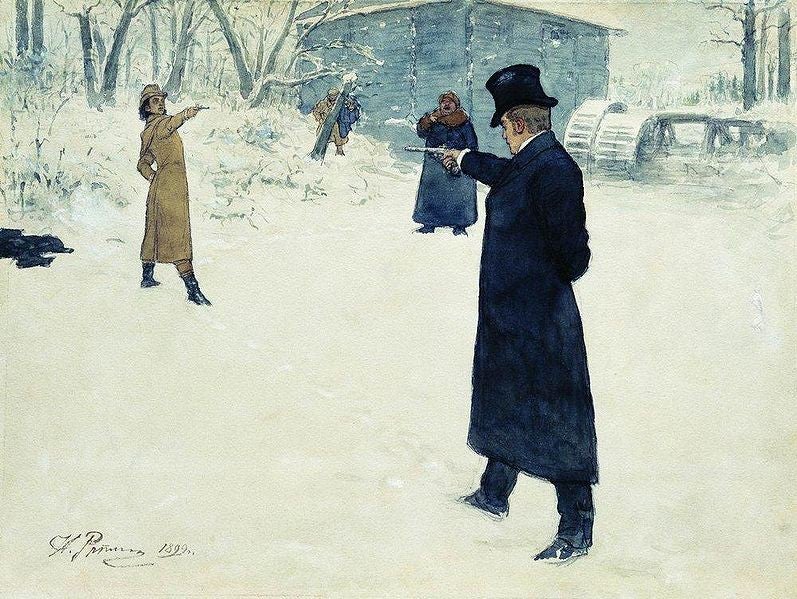
The practice of shooting at someone with the intention of missing goes back to the days of duels. To delope is to throw away a shot. Alexander Hamilton infamously let it be known that he intended to delope during his duel with Vice President Aaron Burr, but Burr shot him dead anyway.


Eugene Onegin and Vladimir Lensky's duel by Alexander Sergeyevich Pushkin [ Many thanks to jdun1911 & mrsatyre for emailing me the tip. ]
 There are different systems of honor that many of us would not consider honorable in the least, but honor is a subjective concept. We must accept, or at least acknowledge that there are different codes (Pirate code, honor among thieves, etc.) that are incompatible with our particular moral beliefs. Truth may be absolute, but morals and honor are interpretable.

But back to the article, why use a flimsy, inaccurate grip as a way to delope? It's not spelled out in the article above, but it is a way to save face while maintaining that hardcore "gangsta" persona. It's primal. It is staring in the face of death and hoping ones adversary desires life as well.

Historically, most duels were a show of honor that one hoped would not result in death (my interpretation), although many did. They were also by and large subject to a Code Duello with resolution mechanisms built in to avoid the duel if at all possible. The code was not law, but it was ingrained in the system of honor.

As the 19th century rolled on, duelists turned pugilists (the increased lethality of pistols probably was a huge contributor) put down their arms and put up their fists to resolve disputes. The era saw the Code Duello evolve into the Marquess of Queensbury Rules for boxing.

As time passed, even boxing to resolve disputes was seen as a barbaric means of maintaining one's honor. In a world of email flaming and nasty Facebook posts, I can see a place for dueling, but in a non-lethal and acceptable fashion. Here is my proposal for when one's honor has been sullied by an adversary:
  • Obtain a copy of John Lyde Wilson's The Code of Honor (print, ebook).
  • Read the book and try to settle the dispute without violence. Have your second handle the negotiations. You do have a good friend to be your second, don't you?
  • If that doesn't work, buy a pair of identical paint ball guns, an inexpensive model like this would fit the bill well. Don't forget the safety gear
  • Abide by the rules. Don't be a brigand.
  • After the affair is settled and your honor is secured, sit down with your "adversary" and your respective seconds for a cup of tea or whatever. Enjoy the fact that you've resolved your matter in a good old fashioned duel and nobody had to die. You might have a bruise for a day or two if your opponent had a well placed shot, but you both get to go home to your families with your egos intact.
[Update: 17 October 2012]
A colleague pointed out that my idea is not that novel. Retronaut documents a 1909 duel where wax bullets were used.

17 May 2012

The honor of a servant

From the experts of ettiquette:

http://www.debretts.com/etiquette/british-behaviour/a-to-h/discretion.aspx

Though the article is about keeping your conversations private in an ever-less-private world, the reference to the English butler reminds me of my favorite character from my favorite show, Mr. Carson on Downton Abbey.

Mr. Carson is the man who knows all the dirt on everyone and is honor-bound to keep it to himself. His love and loyalty to the family he serves is beyond reproach. He seeks no personal recognition for his actions, and considers them just a part of his duties. He may just be a servant, but he is the glue that maintains the entire structure of the house. He may not be the Lord of the Manor, but he is the greatest man in the house. We should all strive to have a little of Mr. Carson in us.

Military tradition under fire

I've read in several British and Scottish news outlets lately that historic regimental names are at risk of being done away with. From the BBC:
MoD to 'protect' regiment names: The Ministry of Defence says it is seeking to preserve the regimental cap badges of Scotland's historic army regiments.
I am very much an advocate for worthy traditions, and having served in the military, it would be a shame for any nation to strip its services of historic institutions and emblems. This is akin to telling the 1st Infantry Division that they can't be the "Big Red One" anymore. I doubt that US military advocates would stand for this, and I hope that our UK counterparts will likewise stand for the Black Watch and protect their military heritage.

07 May 2012

Cinco de Mayo

A great history lesson from Jesús Ávila for gringos like me who see Cinco de Mayo as the Mexican St. Patrick's Day:
The Battle of Camarón, April 30, 1863:
I write this tedious and long entry at this time of patriotic celebrations and to celebrate that infamous battle of May 5, but the main reason is to emphasize something very specific: it is little known about the influence of historical events occurred in that have led our nation in his remembrance flags and / or foreign symbols, that is why today we will have a bit of history in a comprehensive text that can not be summarized.

On July 17, 1861 Mexican President Benito Juarez issued a moratorium on external debt of the country, suspending for a period of two years, after which pledged to resume, this problem opted as historically known as the French Intervention.

It was May 5, 1862 when General Charles Ferdinand Latrille, Earl of Lorencez, commanding the French troops ordered the assault on the forts of Loreto and Guadalupe, who defended the city of Puebla under General Ignacio Zaragoza, the army invader was repulsed with heavy losses while trying to repeatedly take the fortifications. In the end, had to leave the field and retire defeated and pursued by the Mexican cavalry.

In 1863, with the arrival of numerous reinforcements and another general, Frederick Elie Forey, it was decided to strike again Puebla. The new troops received from France were three battalions of the Foreign Legion under Colonel Jeanningros, an efficient veteran with over 30 years of service, who had participated in the Battle of Moulay-Ishmael in Algeria. Two of its battalions landed at Veracruz on March 31, 1863 and the third would in the coming days.

In March of that year, and 13,000 French soldiers marched on the Mexican subsidiary heroic city of Veracruz separating the capital. A French Legionnaires, to their disappointment, they were assigned menial tasks such as guarding convoys in the eastern section, where there were many diseases such as yellow fever and typhoid. In this regard, the commander of the French army, General Elie Forey Frederic, had indicated that he preferred that they were foreigners and French who had the responsibility to defend the most unhealthy area, ie the tropical zone between Veracruz and Cordoba, where reigned malaria.

Since its establishment in 1831 by King Louis Philippe, much of French public opinion regarded the Legion as a disgrace and was deeply offended by the fact that foreign mercenaries were employed to fight the battles of France, for all boxes, except for the officers, but were not French citizens of other countries listed under very difficult conditions.

On 15 April a convoy of 64 wagons carrying several guns intended to demolish the defenses of Puebla, ammunition, supplies and chests of gold to pay troops, sailed from Veracruz. Mexican intelligence was good, because she soon became aware of the existence of this convoy.

The civil and military governor of the State of Veracruz, Colonel Don Francisco de Paula Milan, joined a force of three infantry battalions of 400 men each: the National Guard battalion from Veracruz, the National Guard battalion of Cordoba and the National Guard battalion of Xalapa, plus 800 -500 Lancers cavalry and 300 irregular-to intercept and capture the enemy precious cargo. At first glance appeared to be an easy task, particularly because the Mexican cavalry was very efficient and was armed with repeating rifles, at the same time, maintain the safety of this convoy was of particular concern to the French, why on 27 April the commander of the Legion, Colonel René Jeanningros, who had established his headquarters in Chiquihuite, decided that the third company of the First Regiment of the Legion was to carry out the task of escorting him as tread the area of ​​responsibility. Most of that company officials were ill. Three officers volunteered: Captain Jean Danjou, assistant staff of the company, Lieutenant Napoleon Villain and Maudet Second Lieutenant. These men formed a formidable trio. Captain Danjou was a legionary with several years old who served with distinction in Algeria, Crimea and Italy. In Crimea lost a hand, which was replaced with a wooden prosthesis. Villain and Maudet apparently were French, but enlisted as a Belgian since, as noted, the Legion forbade French citizens enrolaran soldiers. These men started as privates, effectively fought and were promoted to the rank of officers in recognition of the behavior demonstrated in the Battle of Magenta. The company to which they belonged was composed of a total of 120 soldiers, but at that time only 62 men of Polish, Italian, German and Spanish, were suitable for the task.
Captain Jean Danjou

Second Lieutenant Maudet

Lieutenant Napoleon Villain 
On 29 April, four weeks after his arrival in Mexico, the troops under Danjou were prepared to perform this action routine and joined the convoy to protect the next phase of its journey. At midnight the third company, provided with 60 rounds per man, left Chiquihuite in advance mission in anticipation of the convoy to travel to check the path was clear. At 02:30 on 30, reached a post defense prepared by the Legion at Paso del Macho and the commander of this, Captain Saussier, impressed by the small number of the escort, offered a firing Danjou reinforcement, which this declined, continuing the march, for which divided his force into two sections separated by 200 meters away, while he, center, leave with the supplies. Behind was a small detachment of rear. However, lacked advanced Danjou, because the Legion did not have cavalry.

Shortly before 06:00, the third company passed through the village of Camarón, or "Camerone" as the name given by the French, which, like all villages in the region, was half destroyed by the war. The main building, known as the Hacienda de la Trinidad, was a modest little house with adobe buildings around. A mile and a half of shrimp, Danjou ordered his troops to stop for breakfast rations, and as a preventive measure ordered to deploy some sentries. A few minutes later came the alarm. The Legionaries noted that a strong contingent of Mexican cavalry was approaching the place. Danjou immediately ordered his men to prepare their rifles and defensive form a rectangle. The Legionnaires had only a natural advantage in that open field, what was the profuse vegetation, which became a natural barrier against cavalry opponent. When Mexicans were within walking distance, the legionnaires, shouting "Long live the Emperor!" Opened fire blocking their advance. Mexicans chose not to risk a charge and ejecutarron a maneuver to encircle them. Danjou then ordered a retreat to the only place where they could organize and maintain a sustained defense, not the Paso del Macho as some claimed, but the Shrimp farm. In small groups, the Mexican cavalry harassed the company of the Legion while it was heading towards its goal, making your withdrawal hell. Legionnaires twice stopped and drove back with shock. Finally Danjou and most of his men reached their objective but at the cost of rations and ammunition mules. Forty-six of them reached the farmhouse, some wounded, others 16 were intercepted and captured by the forces of Milan. The worst thing for the French was that the Mexicans were able to reach the shrimp almost simultaneously, which were located in the upper and one of the stables located at the corners.

The Legionnaires were in a very difficult position. The outer walls of the ruined property had a perimeter of 50 meters wide and 50 long and a height of three meters. Two large doors on the west side and a hole in the east were the points of access. Furthermore, only had 60 rounds per man. But Danjou was a veteran accustomed to impossible situations. He immediately ordered the clear barricade and deployed his men into defensive position. For Legionnaires' bad luck, the courts were exposed to fire from above and Mexican Danjou could do nothing to neutralize them. Another part of the Mexican cavalry dismounted and ran fierce attacks, but the Legionnaires refused. Shortly after 09:00, in the midst of a scorching sun, Colonel Milan sent a Mexican officer of French origin, the young lieutenant Ramon Laine, demanding the surrender of the legionaries. Danjou dismissed the suit with a resounding no and then went to each of his men who promised to fight to the end.

At approximately 11:00 a bullet fired by a sniper, possibly hidden in the stables, took the lives of Danjou. Villain Lieutenant quickly took command of the defense. Around noon the legionnaires heard the sound of bugles, and the Zouaves, located on the roofs, they observed a column of soldiers approaching. There was a general enthusiasm thinking that it was French military reinforcements, but the excitement soon faded when he realized that Mexican reinforcements were ordered by Colonel Milan, consisting of three battalions of infantry Vercruz the National Guard, the National Guard Xalapa National Guard and Cordoba. The situation was complicated Legionnaires, as well as the loss of their energetic commander, were now surrounded by two thousand enemy soldiers. With these troops, the Mexican fire became more intense and raids occurred more frequently. The hours passed, the heat increased, and the legionaries began to suffer the effects of thirst and dehydration, as water from their canteens had a good time was up. Villain had a defense as courageous as that of Danjou, but around 14:00 hours fell riddled with intense Mexican fire. The command fell to second lieutenant Maudet.

Again Colonel Milan, a man of honor, prouso the surrender of the legionaries, ensuring life. Maudet refused. The Mexicans decided it was the right time to launch a frontal assault and reduce once and for all his enemies. One however was not enough. Consequently, waves of attacks attempted to break the tight defense but the accurate shooting of the disciplined French troops held them. On several occasions Maudet men crossed the yard to help their fallen comrades, which was usually fatal. Failed attacks, Mexicans set fire to the surroundings of the French position, which was becoming a living hell. Great courage was displayed by both parties while the struggle reached its climax. Even the poorly trained Mexican irregular fought with stoic courage during repeated attempts to enter through the doors and windows. The vast majority of them were killed by impact of bullets and bayonets of the legionaries, and their bodies were returned helpless on the patio.
Colonel Francisco de Paula Milan

Around 17:00 hours only 12 remained standing Legionnaires to contain the Mexican offense. New calls were made to surrender not accepted. Surrounded by the corpses of their comrades in arms, were willing to die. At 18:00 hours only had five legionaries, capes Maine and Berg and soldiers Constantin, Leonard and Wensel, who had very little ammunition. Over the next few minutes Maudet, who by then was wounded, ordered his men to shoot the last volley of bullets, bayonets and charge prepare Mexican troops to die with honor. During the fight the legionnaires had fired over 3,000 rounds. In seeking to perform this action Maudet again received a bullet and fell unconscious, while two of his men were killed. The survivors, capes Maine and Berg and satin Wensel, a Polish-retreated to be shoulder to shoulder against one of the walls of the hacienda, presenting their bayonets as the only defense.


Before this show Mexican soldiers hesitated whether to finish them or spare their lives. His doubts were resolved with the emergence of a Mexican officer, Colonel Lucio Cambas Angel, who also was of Gallic origin. After appeasing his men, he addressed his adversaries in perfect French with the words: "Now I guess you will pay."

Corporal Maine realized that although this man had the bearing of a Frenchman and spoke perfect French language was as Mexican as Juarez and therefore an enemy, who, for purely humanitarian reasons, wanted to save their lives. Watching his two comrades, said: "We surrender, but let us stay with our arms and care for our wounded." Colonel Cambas responded with a military salute, and raising his sword in sign of respect said: "A man like you is granted whatever". Cambas demonstrate an attitude of chivalry and the behavior of a true soldier, with a high sense of honor to the army uniform who fought with courage. He immediately ordered the wounded Legionnaires were served.

On being informed of the surrender, Colonel Milan said: "But these are not men, are demons". The Mexicans gave their opponents the major considerations. Twenty-three legionaries were assisted by the troops and 16 of them survived their wounds. He did his best to save the life of Lieutenant Maudet and sent along with a sergeant, also severely wounded, hospital Huatusco, a distance of 80 kilometers. Given the precarious situation of the hospital, Maudet was finally brought home from Marredo Juana Gomez, distinguished Mexican lady known for her charitable work. Despite the efforts provided by Dona Juana, the French officer pass away, but not before writing the following words: "I left a mother in France, I found another in Mexico."
The Mexicans caused the Legionaries 26 deaths: three officers and 23 soldiers, but to turn 300 of his men lay dead and wounded. Nor could they take possession of guns nor the spoils, as the convoy, heard the shots and found a distance, managed to evade the action, bringing the initiative to march in advanced Danjou gave an appropriate result for French interests. The next day, Colonel Jeanningros Shrimp arrived at the head of a column of rescue, but it was too late. The Mexicans had departed, leaving only the bodies of legionaries killed in action. Beside them stood a wounded man, who was presumed dead, with eight bullets in his body, who narrated the heroic episode starring his comrades before superior forces. From prison, Corporal Berg Evaristo was able to get a note to Jeanningros which concluded with these words:

"The 3rd Company of the 1st Regiment Colonel's dead, but she did too, and so it can be said, had a few brave soldiers."
The return from captivity Berg would be promoted to officer. The other prisoners involved in the incident Shrimp, including the 16 Legionnaires captured during the retreat to the farm, ie a total of 32 men, were exchanged for Mexican officers captured by the French and most remained at the legion. The Maine place was also promoted to officer and attained the rank of captain. The other survivors and Wensel, Schaffner, Fritz, Pinzinger and Brunswick were made Knights of the Legion of Honor of France, while the classes Magnin, Palmaert, Kunassec, Schreiblick, Groski Rebares and received the Military Medal.

This extraordinary act of courage, which lasted continuously for eleven hours, was a victory for the French unprecedented moral being fought against all odds. And while a valuable combat unit made up of men loyal and determined to give his life for the French cause had been exterminated, their action helped save a valuable convoy and raised the morale of the soldiers who fought for the implementation of the French strategy in Mexico. More importantly for the traditions of the Legion, the wooden hand of Captain Danjou was found by Colonel Jeanningros in the ruins of the Shrimp and became the most precious relic of the military. Such was the impact of the action of the third company of the first regiment of the Legion, for the rest of the French occupation of Mexico, that country's troops had to stop and present arms when crossing against the estate of Camarón.

The date of the Battle of Camarón was erected in 1904 in a ritual event for the Foreign Legion, and today is celebrated with great pomp and respect in the courtyard of the headquarters of the Legion in Aubagne, near Marseille. The hand of Captain Danjou, stored in a small urn, is displayed in front of the regiments and a count of the battle is read each of the units of the Legion on the day of the ceremonies. The ashes of others killed in the shrimp are preserved in a reliquary, while the Mexican eagle, which became the flagship of the first regiment is paraded around the chapel. The word "Camerone" is inscribed in gold letters on the walls of Les Invalides in Paris.


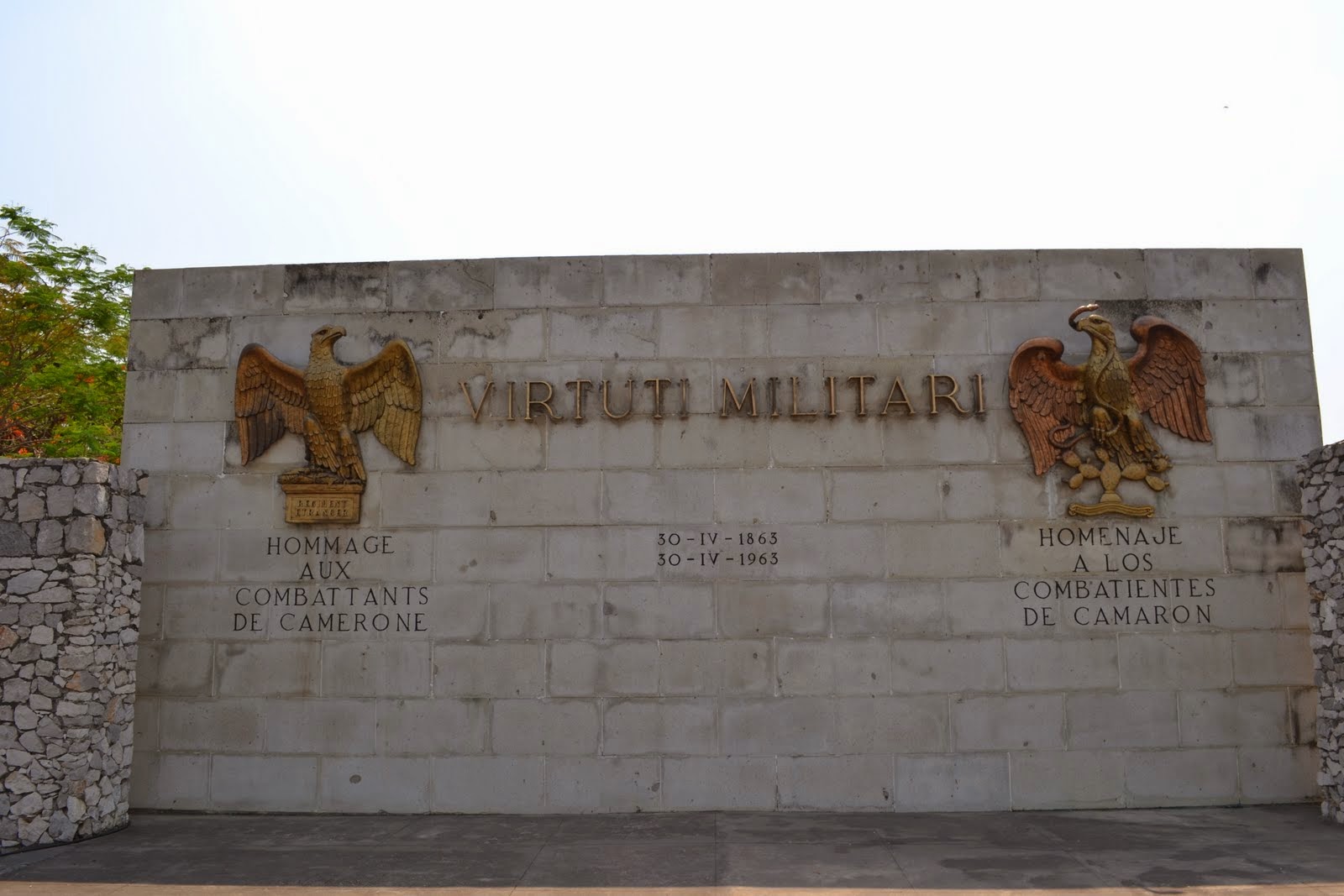
The celebrations have spread to Mexico. In 1892 France was authorized to erect a monument, renovated in 1963 by the Mexican government, at the one hundredth anniversary of this battle, whose inscriptions read: "There were less than sixty opposed to an army. Life these French soldiers left before that courage the April 30, 1863. " The ceremonies are attended by French citizens living in that country and Mexican army officers, for whom of course not surprising the maximum of the Legion: "Every legionnaire Shrimp has carved his heart."